The Leadership Lens
In Uniforms & Workwear, the product page has to do what a fitting room once did — and flat photos rarely manage it. Most uniforms & workwear teams know the pattern: plenty of browsing, plenty of returns, and a fuzzy picture in between. Expectations in Uniforms & Workwear have shifted, and the tools brands use to show their pieces have to keep up. Fit and confidence have quietly become the biggest swing factors in uniforms & workwear. The way a uniforms & workwear brand lets people picture a garment on themselves says a lot about how it converts.
What Keeps Leaders Up
When experiences that stutter on mid-range phones sets in, shoppers hesitate, baskets stall, and returns climb. A recurring challenge for uniforms & workwear is experiences that stutter on mid-range phones. The issue shows up most clearly as Experiences that stutter on mid-range phones during peak traffic hours. It rarely starts as a crisis; experiences that stutter on mid-range phones builds quietly until a returns report or a soft launch makes it impossible to ignore. For a Advisor, Retail Operations, experiences that stutter on mid-range phones is more than an annoyance — it is a steady drag on conversion and margin.
The Strategic Cost
The cost of experiences that stutter on mid-range phones is rarely a single number — it is lost conversion, return shipping, and a catalog that underperforms. Teams end up reshooting and discounting instead of merchandising with confidence. For leaders, the real risk is strategic: a try-on gap becomes a ceiling on how far the brand can scale online.
Rising Expectations
The modern standard is simple: believable, on-body, and instant. Self-serve try-on is the new default; shoppers want to picture the fit without a fitting room. Anything a shopper cannot picture on themselves now feels like a risk to the uniforms & workwear brand. Shoppers now expect to see a garment on a body like theirs — and to do it on their phone.
A Strategic Tool
Since $0 cloud-GPU in-browser rendering sits within the Platform & Cost part of Mirari, it fits naturally into how uniforms & workwear teams already work. Mirari tackles this with $0 cloud-GPU in-browser rendering: Perception and 3D rendering run on the visitor’s device (WebGPU/WebGL/WASM), so there is no per-session GPU bill and scaling stays trivial. Because perception and rendering run in the browser, the experience feels instant — and it costs nothing in cloud GPU.
What to Do Next
Start with the hero pieces and the high-return categories — that is where try-on pays off fastest. Give the brand a try-on that scales with traffic instead of with a GPU invoice. Pilot Mirari on your next drop and measure add-to-cart and return rate before and after.
The Payoff
Shoppers get a believable look at the fit; the brand gets fewer returns and more confident checkouts. For uniforms & workwear, that means reduced reliance the whole team can rely on. The numbers follow the confidence: higher add-to-cart, fewer bracketed orders, and drops that land. The result is reduced reliance, without a render farm or a per-session GPU bill. Brands using this approach see Reduced reliance on costly photoshoots at scale.
Explore Mirari
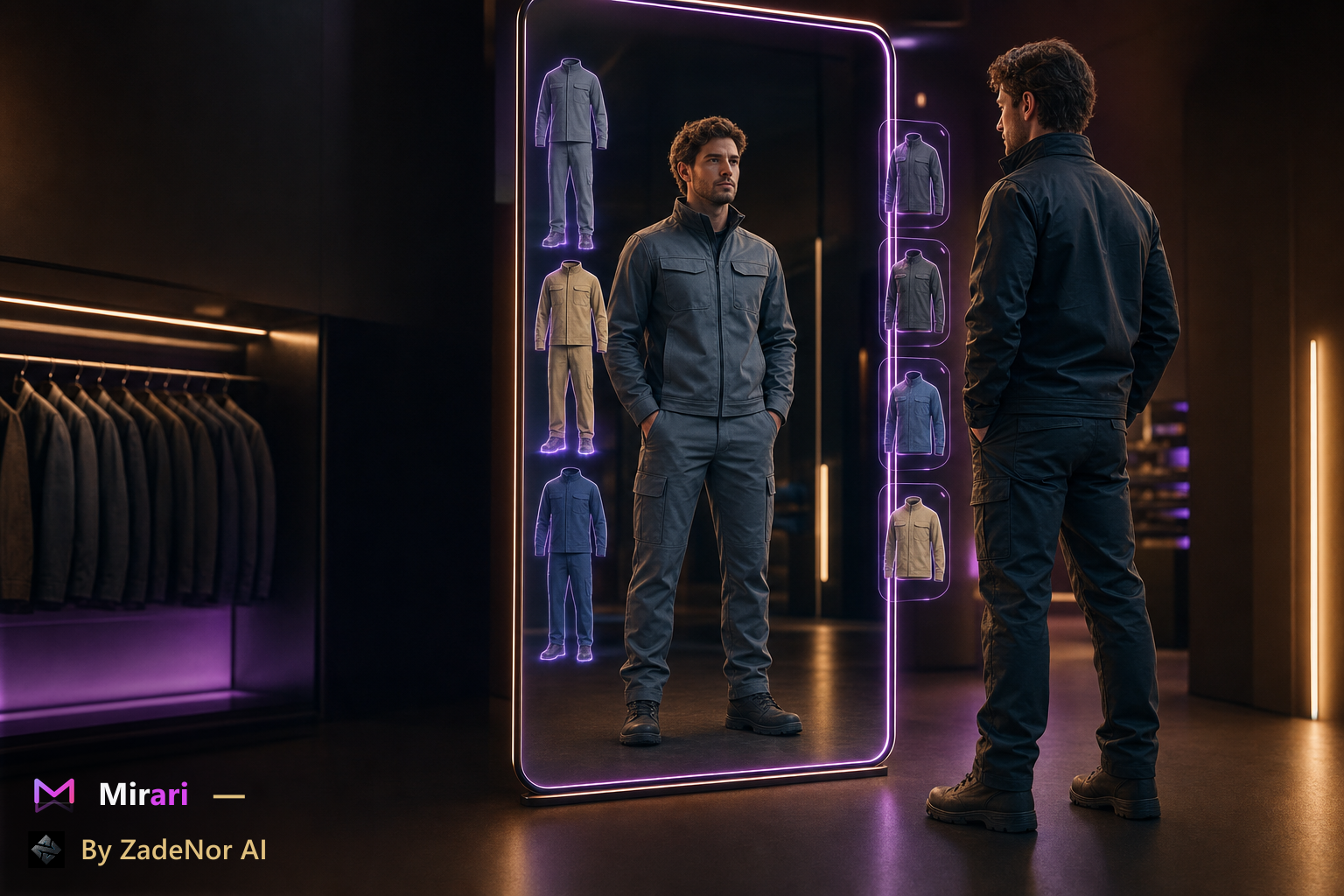
See it for yourself: Mirari by ZadeNor AI composites garments onto real bodies, recolors in real time, generates pieces from templates and exports to AR. Start free today.
Every shopper who cannot picture the fit is a basket left half-built. Over time, experiences that stutter on mid-range phones translates into bracketed orders, costly reverse logistics, and drops that never find their audience. For uniforms & workwear, that means reduced reliance the whole team can rely on. Try-on stops being a gimmick and starts being a default on every product page.
Teams end up reshooting and discounting instead of merchandising with confidence. For leaders, the real risk is strategic: a try-on gap becomes a ceiling on how far the brand can scale online. The numbers follow the confidence: higher add-to-cart, fewer bracketed orders, and drops that land. Brands using this approach see Reduced reliance on costly photoshoots at scale.
Every shopper who cannot picture the fit is a basket left half-built. What looks like a product-page problem is often a fit, confidence and returns problem in disguise. The cost of experiences that stutter on mid-range phones is rarely a single number — it is lost conversion, return shipping, and a catalog that underperforms. Shoppers get a believable look at the fit; the brand gets fewer returns and more confident checkouts. The result is reduced reliance, without a render farm or a per-session GPU bill. Try-on stops being a gimmick and starts being a default on every product page.
What looks like a product-page problem is often a fit, confidence and returns problem in disguise. Teams end up reshooting and discounting instead of merchandising with confidence. For uniforms & workwear, that means reduced reliance the whole team can rely on. Try-on stops being a gimmick and starts being a default on every product page.
Over time, experiences that stutter on mid-range phones translates into bracketed orders, costly reverse logistics, and drops that never find their audience. The cost of experiences that stutter on mid-range phones is rarely a single number — it is lost conversion, return shipping, and a catalog that underperforms. What looks like a product-page problem is often a fit, confidence and returns problem in disguise. For uniforms & workwear, that means reduced reliance the whole team can rely on. Brands using this approach see Reduced reliance on costly photoshoots at scale.